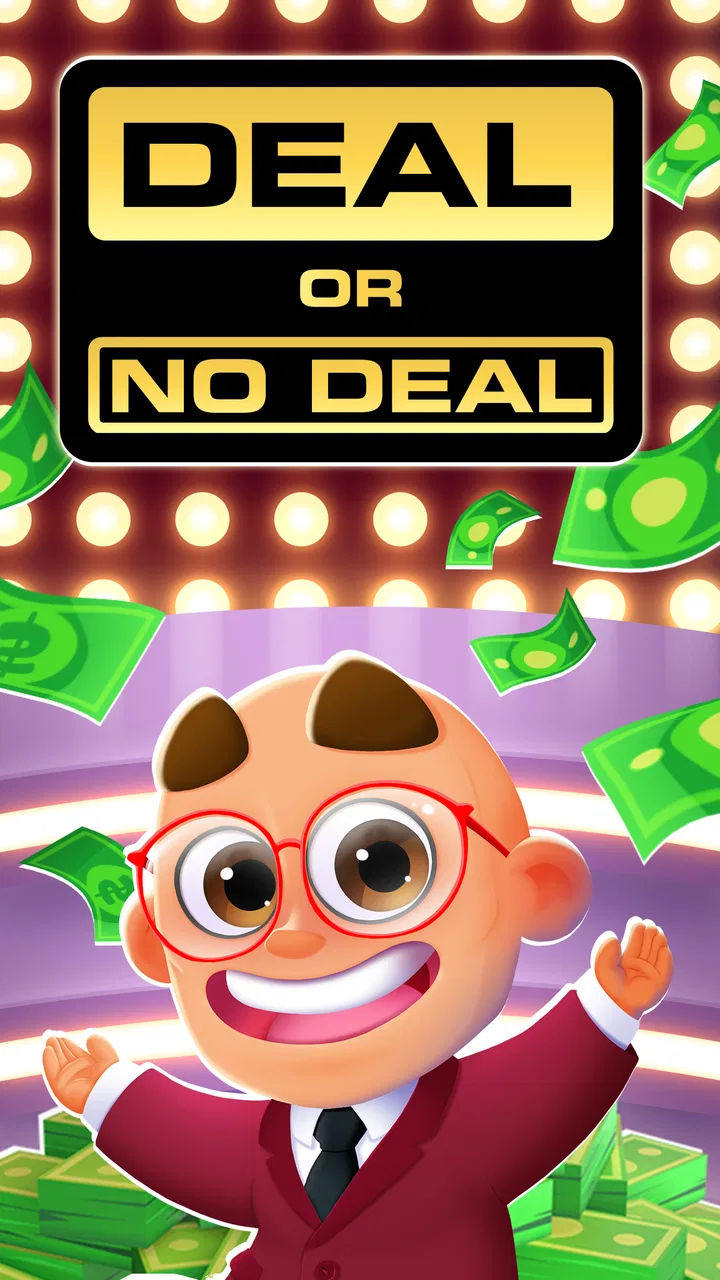
Deal or No Deal
- 4.3
- Rating
- 100.00K
- Installs
- Free
- Price
 Analysis by App-foxy
I approached Deal or No Deal as a quick trivia-and-slots game rather than as a full recreation of the television experience. That distinction matters. The familiar choice between taking a deal and pushing your luck gives the game an immediate identity, but the mobile format is built for short sessions, repeated rounds, and casual entertainment. I found it easiest to enjoy when I treated each play as a small break, not as a serious test of skill or a substitute for a traditional quiz app.
Senior Games presents it as a free game for everyone, with the store summary focusing on official Deal or No Deal slots gameplay. It belongs to the trivia category, although the slot-machine presentation and chance-driven decisions are just as important as answering questions. That combination will appeal to players who like recognizable game-show themes, but it may feel less satisfying to anyone looking for deep trivia knowledge, a long campaign, or a purely skill-based challenge.
How the Deal-or-No-Deal format feels on a phone
The central appeal is the tension created by deciding whether to accept a tempting offer or continue toward a potentially better result. On a phone, that structure works well because it creates a clear moment of suspense without requiring a long explanation. I could understand the basic rhythm quickly: start a round, watch the possible outcomes develop, then make a decision when the offer arrives.
You May Also Like

 Blood Strike: 2.5 Anniversary
Blood Strike’s Loadouts Turn Every Drop Into a Tactical Gamble
A close look at Blood Strike’s custom loadouts: how fast access to signature weapons reshapes its battle royale rhythm, rewards preparation, and narrows the gap between fights.

 Pandora - Music & Podcasts
Pandora’s Music Is Easy to Start, but Harder to Recover
Pandora’s strength is its low-effort path from a seed to a station. Its weak spot is how much confidence it asks you to place in connection, setup, and quiet recovery.

 8 Ball Pool
 Is Built on Rivalries, Rematches, and Routine
A close look at the rivalries, rematches, shared routines, and unanswered safety questions that turn a quick pool match into a persistent mobile community.

 Samsung Music
’s Quiet Strength Is Playing What You Already Own
Its reach comes less from spectacle than from dependable access to a personal library. That simplicity is both the app’s strongest retention engine and its ceiling.

 AccuWeather: Weather Radar
AccuWeather Review: A Quick, Clear Forecast for Everyday Decisions
For everyday plans, the best forecast is the one you can understand quickly. AccuWeather makes rain timing, radar, and local conditions easy to act on, with a few trade-offs.

 Hill Climb Racing
Why Hill Climb Racing Still Turns Crashes Into One More Run
A tiny car, a bumpy hill and one more upgrade: Hill Climb Racing keeps resurfacing because its simple chaos makes every near-miss feel personal.
More From Our News Desk
View All News


That simplicity is also the first major trade-off. The game is easy to pick up, but the same accessible structure can become repetitive if you expect a constantly expanding challenge. The excitement comes from the changing situation in each round, not from learning a complicated system. I would recommend it to someone who wants a familiar game-show mood in short bursts, especially during a commute or while waiting for an appointment.
It is less suitable for a player who wants trivia questions to reward knowledge directly. In a conventional quiz game, preparation and recall can improve your results. Here, the decision-making atmosphere is more about judging risk in the moment. Even when I made a sensible choice, the outcome still depended on the round’s available possibilities rather than on expertise alone.
A practical way to play without overspending
Because the game is free to download but includes optional purchases ranging from $0.99 to $20.99 per item, I think it is worth setting a personal boundary before playing. The safest approach is to decide that the free experience is the test: play enough to see whether the core loop remains enjoyable before considering any purchase. That keeps the decision based on genuine enjoyment rather than on frustration after an unlucky round.
I also found that short sessions make the game easier to judge fairly. If I played repeatedly while chasing a better result, the suspense could start to feel like pressure instead of entertainment. Closing the game after a few rounds helps preserve the game-show feeling and makes it clearer whether I actually like the gameplay or simply want to reverse an unsatisfying outcome.
The purchase range is a concrete part of the experience, but it does not by itself explain what every item does or whether any purchase is necessary. I would therefore avoid assuming that spending improves skill, guarantees a result, or removes every limitation. A careful player should read the purchase prompt in context and treat any optional payment as entertainment spending, not as an investment in progress.
Where progress can feel motivating
The strongest motivation comes from seeing a round develop toward a decision. The possibility of a favorable deal gives the player a reason to pay attention, while the option to continue creates a natural risk-versus-reward moment. That makes the game more engaging than a completely passive slots presentation, even though chance remains central to the format.
My useful tip is to decide what kind of player you are before the offer appears. If you prefer predictable, modest outcomes, accepting a reasonable deal will usually feel more comfortable than chasing the biggest possibility. If you play mainly for suspense, continuing can be more entertaining, but you should accept that the excitement may end with a worse result. The important point is to choose for the experience you want, not because the game makes the larger outcome feel emotionally urgent.
This approach also helps separate progress from pressure. A bad round should be treated as the end of one attempt, not as a reason to keep playing until the result changes. That is especially relevant in a game with optional purchases, because repeated attempts can blur the line between casual play and spending to recover a disappointing outcome.
Fairness, competition, and what the rating tells me
Deal or No Deal is not a competitive trivia app in the usual sense. There is no reason to expect the same kind of fairness standard as in a head-to-head quiz where every player answers identical questions and knowledge determines the winner. The relevant question here is whether the game feels fair as a solo entertainment experience: are the choices understandable, does the risk feel visible, and can I make decisions without needing to pay?
From that perspective, the game’s appeal depends on transparency. A player should be able to understand what is being offered before deciding whether to continue. The game-show format naturally creates suspense, but suspense works best when the player feels responsible for the decision rather than pushed into it. I would pay attention to whether prompts are clear and whether optional spending is presented as a genuine choice.
The public response is encouraging but not definitive. The game has an average rating of 4.2 from around 2.2 thousand ratings, alongside 134 written reviews. That suggests many players find the experience enjoyable, while the written comments are still worth reading for details about repetition, pacing, and purchase pressure. A rating can tell me the broad mood around an app, but it cannot replace my own test of whether the free play feels comfortable.
It has also passed the early-discovery stage with over 100 thousand installs. That gives it a meaningful player base and makes the concept look established enough to attract attention, but popularity is not proof that the game matches every player’s expectations. Someone who enjoys television-style suspense may rate it highly, while a player searching for serious trivia depth could reasonably reach a different conclusion.
Why it is not the same as a normal quiz game
Compared with a standard trivia app, this game places less emphasis on building knowledge over time. A traditional quiz is usually better for players who want categories, correct-answer feedback, and a feeling that practice directly improves performance. Deal or No Deal is better for a player who enjoys a decision under uncertainty and wants the recognizable rhythm of a game show.
Compared with a conventional slots game, it has a stronger sense of choice because the deal decision gives the player a moment of agency. That does not turn it into a strategy game, though. The choice can shape the emotional experience, but it cannot make an uncertain outcome fully controllable. I would not choose it for competitive play, detailed planning, or measurable mastery.
This comparison leads to a simple recommendation. Choose this game if the theme and risk decision are the main attractions. Choose a classic quiz app if you want your knowledge to be the primary tool. Choose a more traditional puzzle or strategy game if you want outcomes to depend mostly on planning rather than chance. The best alternative depends on what you want to feel while playing, not merely on the fact that all of these games are casual.
Everyday situations where it fits
I can see it working well during a short wait when I want something more engaging than scrolling but do not have enough time for a story-driven game. One realistic routine would be playing a few rounds after lunch, stopping before the session turns into a long attempt to improve a result. The game-show structure makes it easy to start and stop because each round has a recognizable decision point.
It can also work as a light shared activity. Two people could discuss whether to accept an offer or continue, even though the app itself is not a substitute for a true multiplayer trivia match. That conversation is where some of the social value comes from: one person may prefer caution while the other wants the dramatic option. The game is more interesting when the decision is discussed than when it is treated as a serious financial or competitive test.
I would avoid introducing it to children as a lesson in money management. The content rating is Everyone, which makes it broadly accessible, but the presence of optional purchases means adults should still explain that in-game decisions and real spending are separate things. The game can be family-friendly in content while still requiring sensible purchase boundaries.
Limitations I would consider before installing
The biggest limitation is the narrowness of the core appeal. If the suspense of the deal decision does not grab you, there may not be enough conventional trivia depth to keep you interested. The theme does a lot of the work, and repeated sessions may feel less fresh once the initial novelty fades.
Another limitation is the relationship between chance and control. The format encourages me to think carefully, but careful thinking cannot guarantee a favorable outcome. That can be entertaining when I am relaxed, yet frustrating when I am trying to reach a particular result. Players who dislike losing after making a reasonable decision should approach it cautiously.
The purchase options create a second layer of friction. Free access makes trying the game straightforward, but the available items mean I need to stay alert to the difference between playing and paying. My recommendation is to avoid buying anything during the first session. First learn whether the basic rounds are enjoyable, whether the pace suits you, and whether the game remains fun when the result is disappointing.
The current version is 2.0.12, and the listed minimum operating-system requirement is Android 7.1. Those details make it accessible to many older Android devices, although compatibility alone does not tell me how smoothly every phone will run it. If you use an older device, I would still judge the experience by responsiveness and battery behavior after a short test rather than assuming that the minimum requirement guarantees an identical experience.
There are also practical questions I would answer through cautious use rather than assumptions. I would not presume that purchases are required to progress, that every round offers the same type of decision, or that a particular outcome can be secured by timing. The responsible approach is to read each on-screen choice carefully and avoid treating promotional language or dramatic presentation as evidence of a guaranteed benefit.
Who should skip it
I would skip this game if I wanted a serious test of general knowledge, a robust multiplayer ladder, or a campaign with clearly measurable improvement. It is also a poor match for anyone who finds chance-based rewards stressful or who tends to spend impulsively after an unlucky result. In those cases, a traditional quiz or offline puzzle game would offer a more comfortable kind of control.
I would also think twice if I wanted a completely purchase-free experience. The game is free, but optional items are part of its commercial structure. That does not automatically make it unfair, yet it means the player should be comfortable managing prompts and setting limits. If that sounds tiring, a paid game with no optional purchases may be a better fit, even if it lacks the Deal or No Deal theme.
My trust verdict after weighing the trade-offs
My overall view is cautiously positive. Senior Games has built a recognizable casual game around the emotional core of Deal or No Deal: evaluate the offer, decide how much risk feels acceptable, and live with the result. The concept is easy to understand and works particularly well in short sessions. I enjoyed it most when I focused on the drama of the decision rather than expecting a deep trivia system.
The free entry point makes it reasonable to try, and the Everyone rating broadens its audience. At the same time, I would not describe it as a pure quiz game or as a skill-first competition. The chance-driven structure, possible repetition, and optional purchases are meaningful considerations, not minor footnotes. The fairest way to play is to treat every round as entertainment, set a spending limit before starting, and never chase a result simply because the previous one went badly.
For a friend who enjoys game-show tension, I would recommend giving it a short trial. I would suggest playing without buying anything at first, noticing how often the decision moments remain enjoyable, and stopping when the suspense starts to feel like pressure. If that rhythm works for you, the game can be a pleasant casual diversion. If you want knowledge, competition, or control to matter more than uncertainty, another trivia or puzzle option will probably serve you better.
In short, this is a focused mobile interpretation of a familiar television-style choice, not an all-purpose trivia destination. Its strengths are immediate accessibility, a clear risk decision, and a format that fits spare minutes. Its weaknesses are the limits of repeated chance-based play and the need for careful spending habits. I would keep it installed for occasional game-show-flavored breaks, but I would not make it my main game for learning, competition, or long-term progression.
FAQs for Deal or No Deal
01What is the main objective of the Deal or No Deal app?
The main objective of the Deal or No Deal app is to simulate the popular TV game show experience. Players select briefcases and eliminate them to reveal cash amounts, aiming to win as much virtual money as possible. Throughout the game, players receive offers from the ‘banker’ and must decide whether to accept the deal or continue playing for potentially larger rewards.
02Is the Deal or No Deal app free to download and play?
Yes, the Deal or No Deal app is free to download and play. However, it may contain in-app purchases and advertisements. These in-app purchases can enhance the gaming experience, such as by offering additional game modes or faster progression. Always check the app store listing for specific pricing details before downloading.
03What platforms is the Deal or No Deal app available on?
The Deal or No Deal app is available for both Android and iOS devices. You can download it from the Google Play Store for Android devices or the Apple App Store for iOS devices. Ensure that your device meets the minimum system requirements for optimal performance and gameplay experience.
04Does the Deal or No Deal app require an internet connection?
The Deal or No Deal app typically requires an internet connection, especially for features that involve social interactions, leaderboards, or downloading updates. Some basic gameplay elements might be available offline, but for full functionality and updated content, a stable internet connection is recommended.
05Are there any special features or modes in the Deal or No Deal app?
The Deal or No Deal app often includes special features such as daily challenges, leaderboard rankings, and various game modes to keep the experience engaging. Some versions may also offer themed events or the ability to compete against friends. Check the app description for details on the latest updates and features.
Pros
- Engaging gameplay with real show feel.
- Simple interface and easy navigation.
- Frequent updates keep content fresh.
- Multiplayer mode for competitive fun.
- Low storage requirement.
Cons
- Ads can be intrusive at times.
- Limited free plays per day.
- Some in-app purchases are pricey.
- Requires constant internet connection.
- Occasional lag on older devices.

Deal or No Deal
Gallery